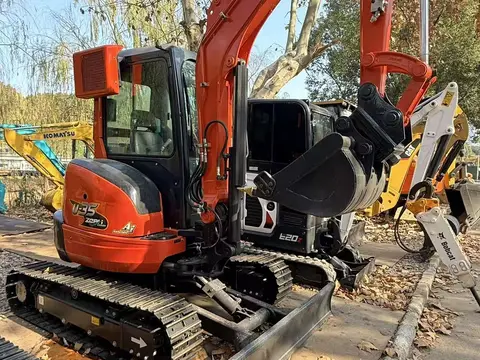
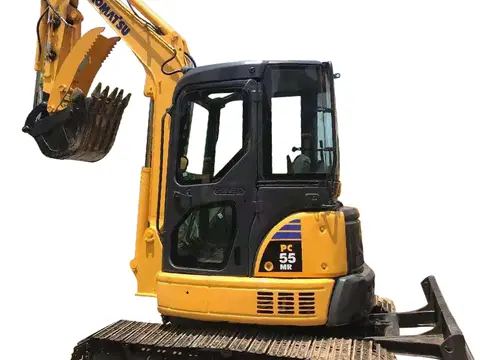
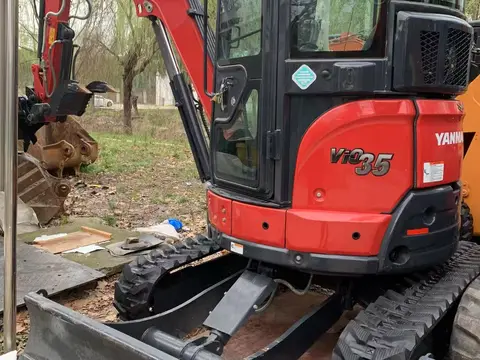
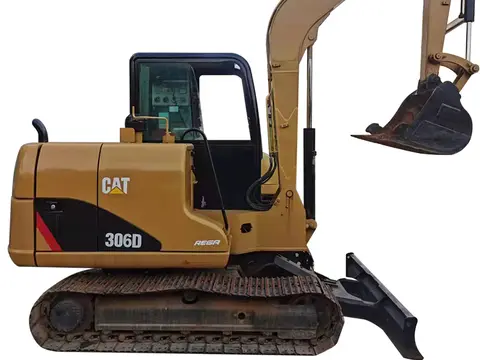
Choose a 1–2 ton machine for gardens and interiors, 3–3.5 ton for general residential work, 5–6 ton for drainage, farms and larger sites. The 3.5 and 5.5 ton classes offer the best resale value.
“Mini excavator” covers machines from under 1 ton to about 6 tons. Choosing the right size is the single biggest decision you will make: too small and the machine struggles; too large and you pay more for transport, fuel and the machine itself. Here is how the classes compare.
Mini excavator classes at a glance
| Class | Typical dig depth | Transport | Best for | Popular used models |
|---|---|---|---|---|
| 1 ton | 1.5 – 1.8 m | Car trailer | Gardens, interiors, greenhouses | HT10 (new) |
| 2 – 2.5 ton | 2.3 – 2.8 m | Light trailer | Landscaping, cable trenches | Bobcat E20, Takeuchi TB225 |
| 3 – 3.5 ton | 3.0 – 3.3 m | Heavy trailer | Foundations, utilities, rental | Kubota U35, Yanmar ViO35, Hitachi ZX35U, Komatsu PC35MR |
| 5 – 5.5 ton | 3.5 – 3.9 m | Truck / low loader | Drainage, farm work, roadworks | Komatsu PC55MR, Yanmar ViO55, Kubota KX057-4, Doosan DH55 |
| 6 ton | 3.8 – 4.2 m | Truck / low loader | Larger sites, small quarries | CAT 306D, Hitachi ZX60, Takeuchi TB260C |
1 to 2.5 ton: access first
Micro and small mini excavators are about access. Many fit through a 1 m gate and some have retractable undercarriages. They are perfect for landscaping, garden pools, indoor demolition and cable laying, but they lack the weight to break hard ground and they become unstable when lifting.
3 to 3.5 ton: the all-rounder
The 3.5 ton class is the best-selling size worldwide. It digs deep enough for house foundations and septic tanks, lifts concrete pipes and kerbs, and can still be towed behind a large pickup in many countries. Japanese models such as the Kubota U35 and Yanmar ViO35 hold their value very well.
5 to 6 ton: the small production machine
At 5 tons you step up to a machine that can do real production work: digging drainage ditches all day, loading trucks and handling a 300 kg hydraulic breaker. The Komatsu PC55MR is our best-selling model in this class. At 6 tons you get conventional-tail machines like the CAT 306D with even more stability.
Zero tail swing or conventional?
Zero-tail-swing machines (ViO, U-series, MR-series) keep the counterweight inside the track width, so you can work next to walls and traffic. Conventional-tail machines (KX057, PC56, 306D) are more stable and lift more, but need more space. Choose by your typical site.
Rubber or steel tracks?
Rubber tracks protect paving and are quieter; steel tracks last longer in rocky ground and demolition. Most minis up to 5.5 tons come on rubber tracks; we can fit either before shipping. Replacement rubber tracks are available in all common sizes.
How many fit in a container?
As a rule of thumb, a 40HQ container holds 10–12 one-ton machines, 3–4 three-ton machines, or 2 five-ton machines. Machines above 6 tons usually ship on flat racks or RoRo.
FAQ
What size mini excavator is best for general construction?
The 3 to 3.5 ton class is the best all-round size. It digs over 3 m deep, lifts kerbs and pipes, and is light enough to transport easily.
How deep can a 5 ton excavator dig?
Most 5 to 5.5 ton excavators dig between 3.5 and 3.9 metres deep, depending on arm length.
How many mini excavators fit in a 40 foot container?
About 10–12 one-ton machines, 3–4 three-ton machines, or 2 five-ton machines, depending on the model and whether the boom is removed.
Our mechanics and export staff test and ship used machinery from Shanghai every week. This guide reflects what we see in our own yard.